Sunday, February 17, 2008

Dead Mothers and Academy Awards


I brought a hastily-selected stack of books with me on vacation last summer, (technically adult books, although most were about kids and teens, sold in the adult market), and was annoyed to discovered that all the ones about young people featured a dead mother. It was dead-mother overload so -- even though they were all well-written books -- before the week was out, I found myself digging thru my dead GRANDMOTHER's books, settling on a dusty old Michener, just to get away from dead moms.

A few people have mentioned the success of Dickens' titles as proof that dead-(parent) books are a perennial favorite, but Dickens' books don't really fall into the dead-mother, angst-ridden category as today's books. Number one: children were much more likely to be orphaned in Dickens' day, so a preponderance of dead parents was a more realistic ratio, and, two: Dickens and other adventure books of that time used the dead parent more as a device to get the child alone, solving problems in his own, than as a heavy plot-point which would permeate the child's every thought. Those books quickly got the parent out of the way, then proceeded with an adventurous plot rather than making the dead PARENT the plot, if you see what I mean.

Somehow, serious books are considered more literary, winning more awards, in the same way that fabulous comedic actors often do not win the big awards until they make a "serious" movie. Let's take the career of Jack Lemon as a small example of this. (This list is from Wikipedia)...

1955- WON - Best Actor/Supporting Role - Mister Roberts
1959- Nominated - Best Actor/Leading Role - Some Like It Hot
1960- Nominated - Best Actor/Leading Role - The Apartment
1962- Nominated - Best Actor/Leading Role - Days of Wine and Roses
1973- WON - Best Actor/Leading Role - Save the Tiger
1979- Nominated - Best Actor/Leading Role - The China Syndrome
1980- Nominated - Best Actor/Leading Role - Tribute
1982- Nominated - Best Actor/Leading Role - Missing

With the exception of "Some Like It Hot," and "The Apartment" (for which, you will note, he was only nominated and did NOT win), every other nomination--and certainly every WIN--was for serious roles. Many of them deeply DEPRESSING roles, in fact. If there is a more depressing movie than "Days of Wine and Roses," I have yet to see it. If you look up any of those other nominated or winning movies, you'll encounter words like "bleak," "bloody," "terminally ill..." the list goes on and on.

True, Jack Lemon was a fabulous actor, and some of the comedies he made in the 50s really were pure fluff. But to imply that his best work was ONLY in drama is to diminish his contribution to cinema. Probably his most iconic role is as Felix Unger in "The Odd Couple." But is it anywhere on that Academy Awards list? Of course not. Because it wasn't a depressing movie.

I believe writers who produce humor suffer the same stigma. Sure, an occasional "Holes" will win. But there are still more dead moms than laughing moms on any awards list. (It's not surprising to note that Neil Simon, who wrote more than 30 screen plays including "The Odd Couple" mentioned above,
who won the Mark Twain prize and numerous other comedy and lifetime achievement awards, has no Oscar statues on his mantel, either.)

I don't think it's the kids (readers) making those decisions, any more than it was the movie goers making the awards decisions, since Lemon's comedies probably made more money than the dramas, and CERTAINLY Simon's comedies did. (Which brings a whole 'nother prejudice into the voting mix: a reluctance to award prizes to financially successful projects embraced by the "illiterate masses.") It's the prejudice of the grownups on the awards committees. In the minds of many of those judges, "serious" is considered more literary than "funny."

Kim Norman

Friday, February 15, 2008

GREAT school visit: Verballoons and Wrist Bands!


Tuesday morning I had a great time visiting the 5th graders of John B. Cary Elementary School, in Hampton, Virginia. What wonderful group of students! They were all so bright and enthusiastic. Same for faculty and staff. They made me feel very welcome. Mel Black, the librarian who had hired me, asked me to concentrate on writing skills, so I came up with a phrase, "Writers Choose Their Words," to show that writers are very careful about what words they choose -- after the 1st draft, of course!

We did a fun activity about verbs where I borrowed a passage from Dawdle Duckling that Toni Buzzeo had sent me. They know Toni and love her; after she visited there last year, she recommended me.

I printed the passage on an overhead transparency, replacing Toni's verbs with more bland ones. Then, for each word, (there were about 6 or 8 of them) I put 4 or 5 alternate verbs into a balloon which I allowed the kids to stomp, releasing the words. They'd read the newly-spilled verbs, and the crowd would pick its favorite. I tried to include at least one silly one in each batch, ("put on deoderant" instead of Toni's much more succinct "preen.") The kids were actually pretty good at picking the same word Toni had. I called the activity "Verballoons."

Even I got something out of that verballoons activity. It really shows how picking the right verb conveys lots of information very quickly. One sentence in Toni's text began:
"Past the marsh with the cattails waving,"

I replaced "waving" with boring old "growing," then, from the balloon they burst, I gave them a selection of:
waving, blowing, nodding, meowing, or whipping.

They chose "whipping," which wasn't too bad, since they couldn't tell from this beginning sentence what the setting would be. Then we talked about how "whipping" is not only a more active and visual verb, it also gives us more information about the setting, that it must be windy in our story. Same with Mama Duck, whom they chose to be "thrashing." So now we had a verb which was not only ulta-visual, but also gave us some idea of Mama Duck's state of mind. It was really a very interesting activity.

[[[UPDATE about this activity, 2010: I've since created a PowerPoint version of this activity which seems to work just as well and is a little easier to transport. All those balloons take a lot of prep ... and a lot of space in my car!]]]

I only wish I'd had time to share the two passages sent to me by Marianne Mitchell (Finding Zola) , and Fred Bortz, ("Dr. Fred," Collision Course!). I have a similar gig in a couple of weeks, so I'll try to streamline the visit to fit in those extra passages, even if we only talk about them, without the balloons.

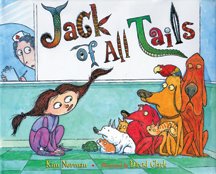
Of course, I shared my Evil Inner Editor photos, which they laughed at, as well as reading Jack of All Tails on transparencies from David Clark's first set of sketches, before the book was published.

As a closing activity, I had them create wrist bands (I'd cut strips of wallpaper old sample books) onto which they affixed stickers which they had labeled with the letters WCTW ("Writers Choose Their Words.") They wrote out the whole phrase on the inside of the band. Mel told me the kids were really pleased with these and wore them the rest of the day.

I was kicking myself that I hadn't brought a camera to get a photo of the wrist bands for my blog. There would have been issues with showing the kids' faces, but a nice shot of all those pretty little brown wrists wearing the bracelets would have been nice.

Mel told me she's putting together a presentation right now and wants to use a similar shot, so she's going to recreate the activity and send me the photo. She's really cool. We totally hit it off and have a lot in common. (She was even a typesetter in a "previous life," incredibly enough! I didn't know there were any more of us still alive. LOL!) Here's her blog about the visit: http://melsplace.blog.com/

Kim

Wednesday, February 13, 2008

"Make My Day" Award Day on Stone Stoop!


Well, how sweet! Liz Dubois just honored me with a "Make My Day Award!" Thanks, Liz! She made MY day, which needed it -- a drizzly day in February when I spent 2 hours in the dentist chair. What a day!

Now I'll pass the honor to these next five folks who always make my day:

First, to Mel Black of Melsplace
She was the gracious hostess of a GREAT author visit I enjoyed yesterday at her school, John B. Cary Elementary School, in Hampton, Virginia.

Elizabeth Dulemba, illustrator extraordinaire, and my favorite go-too gal for all things tech.

Kerry Madden, whose newest book, Jessie's Mountain, was released this week. Jessie is the third installment in Kerry's Maggie Valley trilogy which began with the beautiful, can't-put-down "Gentle's Holler." (At least, I couldn't put it down. Sure wish she didn't too goll-durned far away to sign my copy!) Happy release week, Kerry! She's holding the cutest School Photo contest right now on her blog. I'll dig up an old pigtail photo and send it in. What a cute idea, Kerry! Oh, and I almost forgot to say, you can read my interview with Kerry, when the 2nd book, Louisiana's Song, came out last May. Read it HERE.

I also award my friend Sara Lewis Holmes a "Make My Day" award... just because whenever we get together (all too seldom!), she always does. She has the world's most gorgeous smile. She ain't too shabby a writer, either. Sara is the author of Letters from Rapunzel, a book that I remember in its infancy, which went on to win the the HarperCollins Ursula Nordstrom Fiction Prize!

And last but not least, Joe Kulka always makes my day when he pulls his hunky self away from his workspace and lends his acerbic, and totally-guy wit and wisdom to our critique group. Joe's Wolf's Coming is on FIRE, winning awards and making favorites lists everywhere!

So there is my Make My Day Award list for February 13, 2007. Visit my friends and let them make your day, too!

Kim Norman

Saturday, February 09, 2008

School author visit feedback form


Today I thought I would share the feedback form I (USUALLY!!) send to schools after I have visited. (When I remember.) It serves as a good reminder to me of how the visit went, who I met, ect., as well as giving me feedback about what worked, what didn't, etc.

Plus, it serves as one more little reminder to the folks who hired me so maybe they'll remember my name and recommend me to their colleagues.

I hashed around with this form among my author friends, one of whom has been a statistician in a former life. She suggested I only supply 4 choices (good to bad) since a selection of 1 to 5 allows the reviewer to lazily make a non-committal selection of "3." If there are only 4 choices, they've got to make a firm decision of whether you were better or worse than average. Much more useful information than a 3 out of 5 would supply.

Also in the discussion with authors & librarians, the consensus was that I should only ask about 5 questions, so as not to make too much work for these busy people. Sound advice. And in keeping with the "don't-make-them-work" theme, I also include an SASE with the feedback form. So far, I've received them back every time and most with lots of "4s," I'm happy to say!

Anyway, here's what the form says. Feel free to borrow this and tweak for your own needs...

KIM NORMAN
AUTHOR PRESENTATION FEED-BACK

Name & Title ________________

School Name _________________


Please circle your answers on a scale of 1 (not much) to 4 (yes, very much)

1. Did she hold her audience's interest?
1 2 3 4

2. Was there enough audience participation?
1 2 3 4

3. Was there enough humor in the presentation?
1 2 3 4

4. Did the "props" and/or audio-visuals add to the presentation?
1 2 3 4

5. Would you recommend this speaker to your peers?
1 2 3 4


Please add any further comments, below.

(Here I include 4 long lines for them to write on)


May I use your quote and name on promotional materials? ___________

Thank you so much for your feedback!

###


Kim Norman


PS -- No, that's not my house and mailbox in the photo. Just an old farmhouse I enjoy photographing occasionally during my morning walks.

Friday, February 08, 2008

Google says I'm a poet!


I was shocked (and a little chagrined) to discover recently that I'm the 3rd listing if you Google "Virginia poet." Since I consider myself far FAR below the status of... say... any Virginia poet laureate, all of whom are barely visible on that first results page. Obviously, they're spending their time actually WRITING POEMS rather than improving their search rankings. LOL!

I've also risen recently to 4th, directly below Virginia Hamilton, if you Google "Virginia children's book author." Further refine that search to the Hampton Roads area, (which includes 10 cities with a population nearing two million), I'm the first listing.

I think the recent rise is because I've been doing a little more blogging lately. My rankings weren't too shabby before but they have risen some since getting back to blogging.

One more tip: When you name the homepage of your site, (or heck, you could do it for all the pages) put in a lot of info you'd like the search engines to find. You'll notice at the top of my site, the title of the homepage is ridiculously long: "Kim Norman--Hampton Roads Virginia poet, children's book author and illustrator--Jack of All Tails, Dutton."

The person who helped me design my site is a smart cookie who knew that, around the time my site went up, 3 or 4 years ago, search engines were changing the way they listed rankings to get around the sneaky folks who were artificially inflating their rankings with unrelated links, (like posting a sort of "drive-by" message to very popular blogs, for instance.)

She said engines were also paying less attention to meta tags, since people were putting "hot topic" unrelated tags in their code -- like "Britney Spears," -- but they WERE paying attention to page titles. So my smart cookie web lady said, "Nothing ventured... let's see how much relevant description we can cram onto the title of the page."

So that's probably why I beat out most of the REAL poets in Virginia. (Poetry judges have always grudgingly given me 2nd & 3rd place wins, NEVER first place, since they consider my stuff light verse rather than "REAL" poetry. I guess this is my one form of revenge. Google considers me a poet, at least. )

Kim Norman

Thursday, February 07, 2008

Journal of a school author visit


Since I'm kind of busy right now and it's hard for me to find the time to constantly put new material on the blog, I decided to pull up my journal entry of a past Young Author's presentation...

Went VERY well. Great audience, in the hundreds. Appreciative and generous. Thank goodness I don't get nerves speaking in front of large crowds, because I was NOT expecting such a large audience.

Turned out it was a city-wide event, which means I was performing for teachers from a whole bunch of schools instead of just one. Yeah! A potential source of future author school visits.

FORGOT MY BOOKMARKS!! Really wished I had them since there was a freebie table for all these hundreds of people to peruse while they munched cookies after the presentation.

Learned I'd better have a few extra lapel buttons for my Silly Sign War performers, since I somehow ended up with 6 readers instead of 5. I only had 5 buttons left in my entire inventory. (Note to self: contact Meadowbrook for some more buttons. 2nd note to self: buy some more books from Meadowbrook. I realized mid-afternoon that I didn't have a single copy of the book in my house. The library couldn't find the copy I'd donated, either. Sheesh.)

FORGOT TO READ THE POEM IN ROLLING IN THE AISLES. And that's after going to the trouble to borrow the darned thing from Doris Rea, since I'd sold all my copies.

Thoughts about reader's theater:
Come up with a few places where the whole audience can chime in together. I did this tonight by asking the audience to shout "Do not slap worms" to get my (2) boys reading for "Grumpy Sign #1" in the mood to be grumpy.

After my presentation, I was touched by the writings of an amazing young man, Collin's age, who is an exchange student from Iraq. What a brave, impressive young man. He got a standing ovation... and deserved it.

Was flattered that they had filled the entire left side of the program with my bio, opposite the agenda. Looked like I was somebody! Listed my credits as poet and illustrator as well as my books.

Walked up to a man with a camera whom I assumed was a parent. I'd heard his name mentioned so I told him I had a nephew by that name. Seemed like an amiable young man. He asked me some questions and started scribbling, at which point I realized he was a reporter. So maybe I'll be quoted in the Suffolk News Herald. We'll see. I'm not as interesting as the young Iraqi. (Note after the fact: I was quoted, although I never got to see a copy of the paper, since we don't subscribe to the Herald.)

Was introduced to some very nice women -- reading specialists and/or teachers, I presume -- who were VERY complimentary after the program. One said she liked it so much she'd like to hire me for a teacher workshop. Told her I'd be delighted, and I would! Another encouraged me to put together a proposal for the Virginia State Reading Association -- which I have, since then. What an impressive, vibrant organization!

Kim Norman

Wednesday, February 06, 2008

Why are editors annoyed by rhyme?


On a children's writers list recently, someone questioned editors' frequently saying they object to inconsistent meter. This person wondered something like, ""Isn't a consistent meter always used in rhyming picture books?"

My response:


... well, not in poorly written ones, which is what editors object to. I think the confusion lies in the meaning of "consistent meter." I believe, when editors cite this as a problem, they're talking about the rhythm being "off" within any given stanza, not with a writer switching to another rhythm altogether. Some authors do that brilliantly.

I'll use a snippet of Robert Frost's "Stopping in the woods on a snowy evening" as an example. Here's how Mr. Frost wrote the first 4 lines:

Whose woods these are I think I know.
His house is in the village though;
He will not see me stopping here
To watch his woods fill up with snow.

Now let's pretend that someone ELSE wrote those lines, only they didn't
quite nail the rhythm...

Whose woods these are I think I know.
His house is in the nearby town though;
He will not see me stopping here
To watch for Santa's reindeer.

Okay. That's more than getting the meter wrong. That's also getting the rhyme wrong, since "here" and "REINdeer" don't even rhyme. (You should rhyme from the last accented syllable. "Ring" and "PLAY-ing" don't rhyme either, even though the last syllable is constructed from the same letters.)

But I think that's what editors object to when they mention inconsistent meter. They don't mind if you change up the rhythms now and then to avoid monotony. My 2nd and 3rd books coming out are both in rhyme. In "The Crocodaddy," I did switch the rhythm for the refrain. It's still the same number of stressed beats per line, but with a greater number of unaccented syllables
between the beats. ("Crocodaddy" has a heck-of-a-lot of unaccented syllables! LOL!)

In the third book, "Wee Piggy," the rhythm is fairly consistent, (a basic 4 stressed beats per line), but--to lend a feeling of accelerating events towards the end--I switched to shorter lines, two stressed beats per line. (That's stressed beats, not syllables. Obviously the lines have more than 2 syllables in each line.)

So I don't think it's CHANGING rhythms that editors object to, as long as the change is deliberate and deft. I think they have more of a problem with clumsily written stanzas with inconsistently metered lines that just don't scan in the first place.

Kim Norman

Monday, February 04, 2008

Researching publishers


Amazon is always a good resource when researching any publisher. Just do an advance search and plug in the publisher's name. If they're a big publisher, it's better to select a limited number of years back you'd like to view. Five years or so is usually enough to give you an idea of the type of books that house publishes.

It's helpful when, say, you're researching picture books and you want to find out if they do lots of animal books, or books with cumulative structures. I'll often copy a chunk of a book's info page, including the cover art, then save it into a text file. I sometimes do that when I'm researching publishers who might be a fit for one of my manuscripts. You might not want to pitch to publishers who have produced a book which is TOO much like your current book, (say, a rhyming book about dancing kumquats), but if it's a publisher who does rhyming books, or books about anthropomorphic... er... fruits, you've got a better shot.

Sometimes it can be frustrating, finding a publisher which is a good fit without being TOO good a fit. In my crit group, we all laughed (instead of crying) over a rejection one of us received from Viking which said, "It's great, but we already have a book about blueberries."

Uh. Yeah. That would be Blueberries for Sal. Published SIXTY YEARS AGO. Seems like they could take a chance that kids who read it have moved on. Maybe when a book becomes an icon like Sal, publishers steer clear of ever touching such a subject again. Who knows.

But on the whole, it's a good thing to find houses which have previously published books similar to your own, and Amazon is a quick(-ish) way to do it. Once I've copied a few similar books into that text file, I store it in a folder with the manuscript, titled "Target markets for XYZ (title of the book.)"

Kim Norman

Monday, January 28, 2008

Sample of a winning query


Here's a sample of a query that led to a quick sale. I'll admit, it's a teensy bit "name-droppy," but graciously so, I hope. I guess it didn't bother the intended recipient because she responded within 7 days that she'd like to see the manuscript, which she bought about 10 weeks later. I've since co-presented with this editor in a workshop called "Birth of a book." She said that, indeed, she appreciates your mentioning any acquaintances you have in common, as long as it's a genuine association. And, of course, you'll want to clear the name-drop with your friend before using his/her name.

I'd prefer all names below to remain anonymous, so I've replaced "dropped" names with "(insert mutual acquaintance's name)." And of course, I've removed the name of the editor. Hey, I'm not going to do ALL your work for you!!


(Editor's name & title)
(Publisher's address.)

Dear Ms. (Editor,)

(Insert mutual acquaintance's name), a member of my online critique group, suggested you might be interested in my 267 word picture book, The Crocodaddy, which follows a fearless “Crocodaddy hunter” as he stalks his sly, playful father. I placed the action in a pond, although the game originated between my sons and their father in our tiny backyard pool. The young hunter repeatedly tries to tame the wiley Crocodaddy. He nearly manages in this stanza, when he leaps onto the Crocodaddy’s back:

(Here I inserted 3 short stanzas from the work. Actually, 2 stanzas and a refrain. They're each short-lined quatrains which totaled about 52 words for all three stanzas.)

I’m the author of the humorous picture book, Jack of All Tails, (DUTTON, 2007.) A long-standing member of the SCBWI, I edit their “Highlighter” Mid-Atlantic newsletter. In 2000, I illustrated The Museum Duck, (PEARL LINE PRESS), and my poem, “Mirror, Mirror, O’er the Sink,” was published in Rolling in the Aisles, (MEADOWBROOK, 2004.)

With its summer setting and father/child action, I believe The Crocodaddy has potential as a Father’s Day favorite. I’ve enclosed SASE for your response. I’m also querying several other houses about this manuscript.

Regards,


Kim Norman

P.S. - (insert OTHER mutual acquaintance's name) says “hi,” too! I’m in her in-person crit group, which will miss her terribly when she moves soon!

###

Couple o' notes about my query style:
While I want to appear professional, I try to avoid the kind of stilted business language they used to teach in typing class 30 years ago. So I use contractions where they seem appropriate, and it goes without SAYING that I never use the phrase, "Please find enclosed..."

Oops. I just said it anyway.

If you don't have any names to drop, not to worry. I received plenty of "yes please" responses way back when I knew not a soul in the children's book biz. So as long as you're professional and offer an enticing story, many editors -- even at the biggest houses -- will ask to see your full manuscript if it looks like a good fit for their line.

It's interesting to note that, when we presented that workshop together, my ed said she liked that I mentioned the potential marketing niche of the book, (my mention of Father's Day.) She also liked that I included a snippet of the text so she could get a feel for the story's language.

This letter marked a change in how I worded the information about this being a multiple submission. (It went to one other large house, who also requested the ms. but, alas, it was sold by then. Kind of a nice position to be in, though!) Anyway, in the past, my letters barely whispered the "MS" word... er... words. I'd drop it as a euphemism as far near the end of the letter as possible. Or I'd just put "Mult. subm" way down in the bottom corner.

This time, as you can see, I stated it plainly in the closing paragraph. You never know when an editor coveting a potentially scarce commodity will work in your favor!

Oh, and I'll end on an encouraging note: I misspelled "wily" in the query, (did you spot it?) The editor forgave me and bought the manuscript anyway. So don't let perfectionism get in the way of submitting your stories. Editors like to see clean, professional submissions, but they understand that everyone makes the occasional boo boo. In fact, the editor at that OTHER house, (the one who requested the manuscript after it had sold), is equally forgiving. Once, previous to this submission, I misspelled her name in a query!! She asked to see the manuscript anyway.

Kim Norman

Thursday, January 24, 2008

Musical pitch a learned skill?


I just listened to a fascinating- FASCINATING- podcast from Robert Krulwich's Radio Lab. I believe it's a public radio show that plays in various markets, but we don't get it here, so I listen to it online. This particular show was about how the mind processes music. One expert they interviewed has discovered, in countries where language relies on pitch, that people she has tested from those countries have an immensely larger percentage of the population with perfect pitch. (The ability to identify the pitch of a note without seeing it on sheet music, for instance.)

Some of this is bound to be genetics, of course, but the researcher thinks her studies prove that much of one's ability to distinguish musical tones is a learned skill, acquired during those crucial early years when a child's mind is especially attuned to acquiring language.

Of course, all languages use pitch to some degree, but that's often related to sentence structure, such as the American style of ending questions on an up-note while British speakers often pitch the last syllable downward. But the sentence would still mean basically the same thing, regardless of pitch. This researcher's tests are based on the many Asian languages where
pitch will totally change the meaning of a word such as "ma."

Of course, it begs the question: if you and your children are "stuck" with a language which is not pitch-based, how can you cultivate that kind of ear in your own child? This show doesn't answer that question, but I think it would be a huge argument for exposing one's child to lots and lots of music EARLY. And not only lots of it, but lots of repetition, hearing the same songs over and over again. (And, of course, most children DO love hearing things over and over again. They seem to instinctively know that it's the best way for them to learn.)

Who knows, maybe that's the reason my younger son has such a well-tuned musical ear. When he was not quite two, he spent some months in a body cast. The only furniture that worked to support his odd plaster-encased posture was a bean bag chair where he spent a lot of that time in front of a simple music video of a man singing nursery rhymes while accompanying himself on the guitar. And when I saw a lot, I mean a LOT!

Anyway, here's a link to the show online. I think you can listen to it from the web, and of course also as a podcast. Check out all their other shows, too. They're all GREAT! Click here for the music podcast.

Kim Norman
--
http://www.kimnormanbooks.com/

JACK OF ALL TAILS, Dutton, June 2007 -- IT'S HERE!
THE CROCODADDY, Sterling, 2009
I KNOW A WEE PIGGY WHO WALLOWED IN BROWN, Dutton, 2010

Sunday, January 20, 2008

"No Unsolicited manuscripts?" Doesn't mean you can't send something!


A recent discussion on the Yahoo CW list reminded me of some advice I posted there once about the meaning of the term "no unsolicited manuscripts." Here's the post:

"No unsolicited manuscripts" does not mean you can't send something to these publishers. (Those who are truly closed will say something like "Not accepting submissions.")

"No unsolicited" just means you must send them a one-page QUERY first. If they like your idea and feel your book is a possible fit for their list, they will reply to your letter inviting you to send your manuscript. Then, WHEE! Suddenly you're sending a solicited manuscript.

I understand your confusion. I used to think that "no unsolicited" meant they actually only approached famous people and solicited manuscripts from them. Sounds incredibly naive of me now, but that's honestly what I thought.

You do not have to be previously published or famous or have any sort of contact in the industry for a publisher to take your query seriously. I got many "yes" responses to my queries early in my career, when I didn't know a SOUL in "the biz."
If they wish to see your manuscript based on your query, they'll write back and tell you their company procedure for you to send the now-solicited manuscript. Usually that means marking your envelope as "requested material," or something along those lines.

(Now I know what some people are thinking: "Why not just mark the envelope "requested material" FIRST and send it off? Answer: Editors have good memories. They will not only know they did not request a falsely marked manuscript, they will also remember the deception if you try to contact them later, even if you do it "by the rules" the 2nd time.)

There is lots of information online and in books on how to write a good query. It's a form of marketing yourself. The query serves as a first glimpse of your writing style, so it needs to have personality and yet be professional. I know it seems hard to convey the quality of a million-times-revised story in a li'l old query, but trust me, editors are well-trained to spot potential in a query. Plus, you can always insert a small excerpt from your manuscript so they can get a sense of your style as well. Do a search online or in an online bookstore on "How to write a good/strong query," and you'll hit a mother lode of helpful information.

You might want to read another blog post where I published the query that sold my CROCODADDY to Sterling editor who had never heard of me until she read the query. Read that HERE. I have since sold other books to Sterling, so my query was the start of a great, long-lasting relationship.

Good luck!

Sunday, December 23, 2007

Why I write picture books instead.


Just saw this listing for a children's magazine seeking submissions:

"Publishes ideas, activities, crafts and tips for different ages. No fiction, prose, or poetry. Feature articles 1,000-2,200 words - payment $75 to $400. Teacher and Parent Tips 200 words - payment $40. Games, crafts, and activities 200-500 words - payment $40."

Holy cow! Talk about slave wages. And, from my perusal of the Children's Writer's Market, this is a fairly standard offering.

The last picture book I sold is about 575 words. I was paid thousands for it. (None of your biz exactly how many thousands, but more than ten times the top pay above, let's just say.) The one before that was about 225 words. Also paying WAY more than the measly 40 bucks offered above for 200 words.

And I'm a new, mid-list writer, not a superstar. My earnings are measly compared to theirs.

I know not every story fits as a picture book. I know new children's writers are often told that magazines are a good way to break in. But are they? I've heard of people waiting as long for their $25 poem to appear in a magazine as it takes for my books to land on bookstore shelves.

Maybe that's not true about smaller mags. Maybe with them, the time from sale to print is only a few months. And there's something to be said for the instant gratification of a quick query and sale. But my 3rd book was bought about 2 or 3 weeks after I queried my editor. (Granted, it was a query to an editor with whom I had a pre-existing relationship, not a slush pile submission.)

And even from the slush pile, with my 2nd sale, the editor replied to my query in 7 days. She bought the book about 10 weeks later. Not such a bad wait.

I know there aren't as many places to sell a picture book as an article. But these insulting wages are just... well... INSULTING. So my radical opinion is, if you're going to write, write for a venue which compensates you properly for your labor and inspiration rather than arrogantly assuming you'll be thrilled with the pittance they're paying just to see your byline in print.

Monday, December 10, 2007

Absurd!

December 10th, and here I am outside in a t-shirt, STILL picking up pecans, and it's about 76 degrees outside! Ridiculous. Sorry all you folks everywhere else in the country, hunkered down in snow and ice storms.

I thought how absurd it was as I entered the house and felt the heat around the door which sports my Christmas wreath. The only thing that reminds me it's December is this nasty cold. Blecch! Hope my voice is usable by Thursday. I've got a school presentation that night.

Monday, November 05, 2007

Pecans!

Well, it's that time of year again, a time I always look forward to... and not just because the temperatures are lower. (Although that's a big part of it!)

It's also the time I can spend hours day dreaming, thinking up new plots, while I harvest pecans. We've got a good crop this year. See...?


In case you're wondering, that long-handled gizmo is a tool many of us have in the south for picking up pecans while sparing our backs.

Tuesday, October 30, 2007

Something welcome this way comes...


...and his name is Alan Gratz!

It's my great pleasure to host Alan Gratz on the 2nd day of his book tour. Alan's 2nd book, Something Rotten, has just been released from Dial Books. His first, Samurai Shortstop, came out in 2006. It's great to have you here, Alan. I'm just going to launch into my nosy questions!


1. I know you've written drama as well as "book" fiction. How do your skills as a drama writer come into play when you're writing a book? Is there a difference in pacing, dialogue, etc.?

Dialogue is of course very important on the stage. Most directors want to strip out the stage directions I write anyway, and just use the words I've put into the characters mouths. Writing for directors who do that made me much more conscious of my stage directions. I began putting in only those directions that were vitally important to the scene and leaving out a lot of the little things like "he pours a coffee" or "he stands." I'm learning to cut out a lot of those in my novels as well. There's just so much sitting and standing and looking and nodding and such a character can do before those things become meaningless in a book. I still find them sprinkled throughout my manuscripts, but I'm learning to cut those out as much as possible. Punctuating dialogue with actions like that helps to pace things, but I'm focusing now on making those actions more specific and meaningful, or perhaps expressing them in more creative ways. "The look on his face told me my idea stank worse than a weightlifter's armpit." That kind of thing.


2. I love that you survived a "humid childhood." Haha! So did I! Do you think you write in a southern voice? Or just a moister one?

I've been thinking more and more lately about whether or not I'm a "Southern writer." *Technically* I am, as I was born and raised in the humid climes of East Tennessee and now live in the more temperate mountains of western North Carolina. But geography alone does not define "Southern writer," at least not in the way I think of it. When I think of Southern writers I think of William Faulkner, Eudora Welty, Flannery O'Connor, Lee Smith, Larry Brown, Cormac McCarthy--authors whose stories are in and *of* the South, whose palettes are filled with people and places that are unique to the region. Samurai Shortstop was written in Knoxville, Tennessee, but it certainly does not qualify me as a "Southern writer." Something Rotten comes closer, however. I chose to set my modern retelling of Hamlet in a fictional Denmark, Tennessee, which I place on the map somewhere near Knoxville. The novel's landscape is Appalachia, but does that make me a Southern writer? I'm still up in the air on that one. I'm not sure Something Rotten is *about* the South. It's just set there. I'd like to be thought of as a Southern writer--there's certainly a wonderful literary tradition here--but I may need to write something where the South is almost another character to really put myself on the map.

3. How do you handle the muddy middle of a long book project, when you're past the exciting beginning but far from the breathless finish?


Outlining! My stories used to sag in the middle like a carnival pony until I learned the art of outlining before writing the first word. Now I don't hit that big dead space in the middle anymore between how I knew the story began and how I knew it ended. When constructing the outline, I focus on making sure that something happens in each and every chapter that moves the story forward. That sounds simple, but it's really harder than it sounds. There's all kinds of opportunity in a novel to stop and dwell on the philosophical meaning of something, or veer off into an internal monologue or an aside, and many modern novels relish in this. When writing for young readers though, I try to keep such musings to a minimum--or at least fuse them with action. It's not that young readers can't understand* deep thoughts, it's that many of them don't want to make time for them. There are just too many things begging for the attention of young adults. I feel that competition, and I do everything I can to beat it. Besides, that's the kind of book I enjoy reading too. :-)

4. How do you think YA differs from adult fiction, since so many barriers have come down about sex, language and violence in YA?

The difference for me will always be one of perspective. Adult books may have a teenage protagonist, but are often couched as nostalgia or remembrances, or the books stand away from the character and make observations that come with the maturity of years. Young adult novels, on the other hand, are immediate. The characters live *in the moment,* as real teenagers do, often giving as little thought to what happened last year as they do to what will happen a year later. With no subject taboo anymore, YA isn't an issue of content, it's an issue of point of view. Teenagers have a limited point of view due to their age--they just can't have seen as much of the world as an adult, and so their viewpoint is unique. For them, every relationship is the best they will ever have, every breakup the worst they will ever have. A bad test score means the Worst Day Ever, a sports victory means the Greatest Day Ever. They've yet to learn that these ups and downs are a never-ending part of what it means to be alive, and I love them dearly for that. For young adults the world is constantly new, which means that everything, from the mundane to the taboo, is a totally emotional experience.

5. Do you plan to retool any of Shakespeare's other plots? Or perhaps to continue to write for this character, now that you know him so well?

Yes! I've already sold two sequels. The first is Something Wicked, which is based on Macbeth. My detective Horatio Wilkes will return, this time following his friend Mac and Mac's girlfriend Beth (yes, you may groan now) to a Scottish Highland Festival in the mountains of East Tennessee. There he'll solve a murder, fall in love, and wear a kilt, though not necessarily in that order. Something Wicked will be published by Dial next fall (2008), and will be followed in the fall of 2009 by Something Foolish, based on A Midsummer Night's Dream. I haven't written that one yet, but it will be set at an all night keg party where Horatio must solve a date rape and repair a few broken relationships. I have plans too for Julius Caesar (think toga party at a college fraternity) and The Tempest (Horatio interns at a Disney-like theme park ruled by an animatronics wizard), and hope to sell those if the first three books do well. I'll keep writing mysteries based on Shakespeare as long as people keep reading them!

6. Have you any plans to write for a younger audience?

I have sold a middle grade novel (ages 8-12) called The Brooklyn Nine, which follows nine "innings," or generations, of an American family as told through the children's connections to baseball. It's American history, family history, and baseball history all rolled into one. The Brooklyn Nine is currently slated for release in spring of 2009--just in time for baseball season! As for anything younger, I have a few ideas for intermediate reader series, but my plate's so full right now I wouldn't have time to write them!

Thanks Alan.

Thank you, Kim!

Don't miss Alan's other blog appearances this week:
Monday: Elizabeth O. Dulemba
Wednesday: Karen Lee
Thursday: Kerry Madden's Mountain Mist

Thursday, October 04, 2007

The Elements


Couldn't help bragging about my son, who -- with a little bribing -- memorized the period table of elements, sung along with the the hilarious Tom Lehrer song... which is, of course, originally a Gilbert & Sullivan song.

If the picture quality is too bad, (and you'll really miss out if you don't see his dancing eyebrows keeping time to the music!), hop on over to YouTube and view it by clicking here.

Tuesday, September 25, 2007

A truly odd guest!

No, just kidding! There's nothing odd about my friend, Karen Lee. But she certainly is special! She is the illustrator of two Sylvan Dell titles, One Odd Day and My Even Day, as well as BOTH author & illustrator of ABC Safari. She's joining me today on the 2nd day of her blog book tour.


It's great to have you in for a visit, Karen. I'll just jump right in with my questions!

Who are your favorite illustrators? Do you feel they influenced your work?


My favorite of all time is NC Wyeth – my son’s middle name is Wyeth in his honor. Among contemporary illustrators I admire Adam Rex , Tony DiTerlizzi, Peter Ferguson, Kadir Nelson, and Tim Bower . If you look at the work of these artists you can see some of the same elements; powerful design, masterful execution, drama, style, but all with something uneasy about them. These artists’s work all challenge the viewer rather than simply lull them. That is exciting to me and something I aspire to do with my art.

Now that you're a southern girl like me, (after your Ohio childhood) do you think your southern lifestyle has had an effect on your work? Or does it just make your materials melt faster?

I love living in the south and have for about nineteen of my adult years which is crazy because I’m only 29, but that is a whole other interview. It’'s pretty laid back and I love being able to be outdoors year round. I can'’t seem to think clearly unless I’m moving. We are fortunate to have a paved greenway path near our house and I do almost all of my best thinking while walking the dog every morning. There is also a strong writing tradition in the south and I think it has given me access to some phenomenal role models.

And what ABOUT that Ohio childhood... how did it affect the artist you are now? (And I mean artist in all senses, including your writing and any other arts to which you may lend your talents.)

I am the second oldest of five kids born within five and a half years so my poor mom didn'’t have much time to entertain me – she hardly had time to breathe – can you imagine? Just about all of my most vivid early memories are of either art or of books. I read all the time and I remember feeling anxious that my small town library was running out of things I hadn'’t read. I read anything I could get my hands on from my dad’s scientific journals to my mom’s Redbook Magazine. Back then Redbook featured great fiction and always had lots of short stories coupled with art from wonderful illustrators. It was my introduction to writers like Judith Viorst and artists like Charles Santore. I even read almost all my dad’s collection of classics from Shakespeare’s comedies (couldn'’t do the histories and only a few of the tragedies) to Hawthorne, Doyle, and Dickens.

The books I remember the most from my childhood are an illustrated David and Goliath that I checked out of the library over and over, A Wrinkle in Time by Madeleine L’'Engle, The Lord of the Rings by J. R. R. Tolkien, and Illusions by Richard Bach. It’s interesting to me that several of these books have essentially the same theme – the triumph of good over evil at great odds. It is such a universal story.

We lived in a small suburb of Cleveland and, as a teenager, I took a bus into Cleveland to attend Saturday classes at the Cleveland Institute of Art. That was the perfect combination of freedom and creative stimulation for me and probably influenced my decision to go to an art college more than anything else.

Do you prefer illustrating your own books or the books of other authors?

That’'s an interesting question and I’m not sure how well I can answer it yet because I’ve only illustrated one of my own books. I can say that while it is satisfying to be able to have control over the entirety of a book it also comes with the burden of being solely responsible for the success of that creation. There is something to the gestalt that comes from two or more minds coming together to make something greater than the sum of its parts and I think that has happened with One Odd Day and My Even Day.


Do you have other books in the works that you have authored?

I have two manuscripts that I am currently storyboarding and maybe here I can shed some light about how I feel about illustrating my own work. One of these stories is a quirky, creepy story that I don’t feel adequate to do the finished art for. I have convinced my husband, illustrator Tim Lee www.leeillo.com to collaborate with me on the art in the event that it gets accepted. He can bring something to this picture book that I can’t pull off alone and he also is much more experimental than I am and will push the art to a level that matches the story better.

The other picture book I am working on is also a story that wouldn'’t be well matched for the style of work I am currently doing but this one is my challenge. I am hoping that when I begin the sketches for this I will launch my work into a new direction. This particular story has also been a departure for me - it is written in prose after several years of writing primarily in rhyme.

I know Sylvan Dell is a well-respected publisher which does a good job of promoting its authors and illustrators. I've met Lee German, your publisher at Sylvan Dell and he's a great guy! Since many beginners start out thinking they would like to be published only by a "big" house, can you share some of the things a smaller publishing house has to offer which may even be superior to a big publisher?


I have loved working with Sylvan Dell. Besides being extraordinarily friendly, they have a real passion for what they are publishing. For me the assets are that the author or illustrator has greater creative freedom. They will also keep these books in print and remain committed to them long after most big-house books are out of print.

Karen is also on tour the rest of this week, so to get more in depth information, follow her to the blogs of our other talented friends:

Elizabeth O. Dulemba
Kim Norman
Ruth McNally Barshaw
Barbara Johansen Newman
Dotti Enderle
Kerry Madden

Saturday, September 22, 2007

Here piggy piggy... SOLD!!


Wee haw! Just sold book number three a few days ago!! To my editor at Dutton. What a relief. I was beginning to worry that my first sale to her was a fluke and I'd never write anything which appealed to her again.

This is a rhyming pic book based on "I know an old woman who swallowed a fly." If we don't change the title, the new book is called "I know a wee piggy who wallowed in brown." Color concept book, obviously.

This will be my 3rd book. I'm almost starting to feel like a real-live author! (I guess the "rich-and-famous" prefix will come later!)

Saturday, September 01, 2007

Apples!


Played Martha Stewart for a while on vacation. Picked apples from my grandfather's old apple trees, planted over 50 years ago, and made two batches of applesauce. (The first batch, more virtuous with cinnamon & Splenda, and the second with plain old sugar.)

Gathered the apples in this grand old picnic basket of my grandmother's. Knocked off the cobwebs and removed the little shelf inside which was obviously an innovation to allow for "non-squashed" sandwich transport.

Apples were a popular theme during this vacation. I discovered these old cookbooks on my grandmother's shelves by "Mrs. Appleyard." They're a hoot. More like novels than cookbooks, written by a woman named Louise Andrews Kent in the 40s & early 50s. Mrs. Appleyard is an invention with her crisp New England matron's attitude and speech patterns. Often very funny. The funniest part was that my 13-year-old son decided the books were funny, too, so he began to read them aloud to me, only, instead of trying to sound like, say, Julia Child, he read them in his deep "movie announcer voice." Either way, it was a pleasant way to pass the time while I peeled apples. Nice to get him away from the video games and spend time with his old mom.

I made enough to bring home a batch to his older brother who had stayed home to work.